
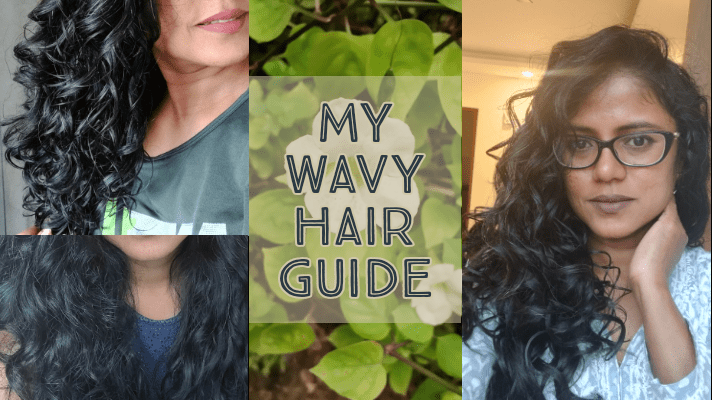
Whether you are a newbie CG or 6-9 months into following the Curly Girl Method (CGM), this is for you. By the time you hit your 1st milestone year, I am sure you are in a better position to understand your hair. By now, you would have zeroed in on a set of products, routines that you can repeat, methods that help you and finally the dos and don’ts for your wavy hair.
So, grab your notebook and take some pointers. This is the guide that I followed for my hair in my first year, and I still go back to it at times, when I have to start from the basics. Yes, it can happen that you have hit the wall, or had a BAD haircut or no products or routine are working for you. Then take a deep breath – CLARIFY and start from basics.
How do you start CG?
You go to naturallycurly.com, find your hair type, porosity – find a web store and buy products for your pattern-type OR pick your favorite Insta blogger’s recommendations. You then expect that your hair will look like theirs. What’s worse, you think your wavy hair will get curly like theirs.
Assumption: You have either picked up Lorraine Massey’s “Curly Girl: The HandBook” or “Curly Girl: More Than Just Hair… It’s an Attitude” book and read all about the Dos/Don’ts of Curly Girl Method.
But a few months into CGM, reality strikes. You find out that your hair won’t turn curly. And products that you lovingly chose from your favorite Influencer’s list does NOT work for you.
I must admit as a Instagram blogger myself, I do not welcome DMs that ask me to list my favorite products. Well, I may even list them for you, but believe you me, it doesn’t work that way.
My favorite CG products may NOT work for you.
You can see my wavy hair texture and think our hair looks the same. But that is where the similarity ends. Let’s consider a few dissimilarities:
- Hair may react differently to ingredients: Coconut oil and coconut-based products may not work on every hair. Dry, coarse, stiff hair can feel drier, coarse, hay-like if you continue to douse your hair with coconut oil. Continued use of coconut oil on such hair can lead to protein buildup. There are some curly -wavy friends who swear off Shea Butter, Xanthum Gum, Gaur Gum, Aloe Vera, Flax Seed, etc. you get the drift.
- Scalp may react differently to ingredients: Scalp sensitivity is a real thing. While you are being very careful not to cause any flare-up/acne breakouts on your skin, you don’t pay much attention to your scalp. And therein lies the problem – you don’t believe that your scalp is sensitive since you cannot see any visible signs. But flakiness, itchiness, small blisters, sore scalp is all a sign of scalp sensitivity. You cannot dismiss allergies, psoriasis, eczema, seborrheic dermatitis when picking up products for your hair.
- Hair can be protein-sensitive: Use a product that mentions hydrolyzed proteins – wheat, oats, soy, etc, or silk protein, keratin, collagen and you find that your hair feels crunchy, hard, brittle even. And that’s your cue for protein-sensitivity. But let me burst a little bubble, I diligently followed the moisture-only recommendations, read favorite products listed by a Insta blogger until one day I went in for an intense protein treatment and my waves felt bouncy for the first time.
- Hair may react differently to water: Most of the CG products are thick (though aqua-based) and need water to work. Haven’t you heard the common mantra: “Apply products on wet hair!”. But hey, if you have high porosity adding a lot of water while styling can easily flush out all the effort that you put in styling. Some hair react well to damp styling. Mine doesn’t, it needs water though.
So, now that is settled, please repeat after me,
“Favorite products of my favorite Insta blogger may not work on my hair.” You need to experiment to learn what works for your hair.
I know following CGM or a modified version of CGM (with shampoo, oils, etc.) can be quite overwhelming. But what if there is a way to simplify it. Besides knowing your hair pattern, you need to understand hair properties that will help you improve your hair health and bring about the “ta-da” magic.
What should we find out about hair properties?
You know by now that hair is non-living fiber. And, hair is made up of protein called Keratin. And I am sure you have comes across a lot of scientific articles that talk about hair being made of amino acid chains and bonds – that’s nerdy stuff. Now, the bonds that make the hair and the layers and cuticle all respond to 3 things – they are:
- Moisture
- pH
- Lubrication
Manipulating these three things are per our hair properties will help us take care of our hair and its styling.
Whether you are someone taking the plunge into your natural hair journey or finding it difficult to stick to the CG way, know it is possible to take care of your hair if you know the properties of hair. Knowing your hair properties is important because it defines how your hair feels, how it reacts to products and how to best style and take care of it.
Surprised how we can do that? Read on…
What do hair properties indicate?
Hair Texture: How much protein your hair needs
| Texture Type | Fine hair | Medium hair | Coarse hair |
| How to recognize it | Limp hair with lots of flyaways (feels dry very fast), can feel greasy at times | Normal hair, doesn’t feel weighed down, but has decent volume | Thicker, stronger hair, can be dry or brittle at times |
| How to rectify it | More protein | Less protein | No protein |
Hair Porosity: pH to help hair absorb and retain moisture
Porosity is simply how much ‘open’ your hair strand (cuticles) is to absorb and retain moisture. And pH comes into play here. Alkaline pH products closes the cuticles and Acidic pH opens them.
According to Naturallycurly.com, our hair typically has a pH between 4.5 to 5.5 (that’s acidic) and that’s why we need it to maintain the same for good hair health.
| Porosity Type | Low porosity | Normal porosity | High porosity |
| How to recognize it | Resistant hair – almost has a “NO ENTRY” policy for moisture, even no exit 🙂 | Absorbs moisture readily | Absorbs moisture readily, but loses it easily too. High porosity can be caused due to chemical treatments or chlorine or excessive heat and coloring, etc. |
| How to rectify it | Focus on getting those cuticles open for product absorption. Use alkaline products or simply heat to coax your hair cuticles to open. | Regular application of regular CG products, pH balanced ones will work here. | Focus on closing cuticles to prevent products from getting rinsed out. Acidic products will help here. |
Hair Elasticity: Protein or Moisture to keep it lively
Elasticity is simply the ability of your hair to stretch and return to its original length without breaking.
| Elasticity Type | Normal elasticity | Low elasticity | No elasticity |
| How to recognize it | When wet, this hair can stretch easily and get back to original length | Brittle hair, when stretched can snap or not return to its original form. | Dry hair, has no ability to stretch |
| How to rectify it | Stick to Protein: Moisture balanced products | Add more protein than moisture | Add more moisture than protein |
Hair Density: What stylers would help for your density
Hair density = number of hairs on scalp/square inch
| Density Type | Thin density | Medium density | Thick density |
| How to recognize it | Less volume, can see the scalp very easily, without having to part the hair | Medium volume, can see the scalp a bit at a time | More volume, cannot see the scalp, unless you part the hair |
| How to rectify it | Don’t focus on definition, only volume. Frizz=Volume, so don’t worry if you see flyaways. Use light stylers on your hair. | You are the lucky ones, you can go with no stylers too. Use medium-hold gels for styling. | Your hair needs effort to keep it in place. Training your hair with finger coiling will help. Use hard-hold gel for adding definition to your hair. |
Disclaimer: The above guide is for reference only. Please use this as a starting point to learn your hair properties. Try the solutions mentioned here to observe how your hair responds and understand what your hair needs.
Finally.
About my hair
In spite of my observations and secondary research into understanding hair properties, I found that my hair needs vary.
- I am wavy textured – having 2b-2c waves, low porosity, thin to medium density, low to normal elasticity hair.
- I have been following the modified Curly Girl Method, (since I use shampoo to cleanse) since 2+ years now.
- I use heat to let products enter my hair, during deep conditioning. In fact, I also cleanse and style with hot water.
- I prefer wet styling, but excess water doesn’t help me.
- I prefer using medium to hard hold gels. Using light stylers of medium hold gels make me lose my wavy patterm easily, leading to frizz.
- But, there are days when I go without any styling and I enjoy plain straight hair. 🙂
It took me years to learn that my hair has a mind of its own, and the Curly Girl Method (CGM) was the only way to become friends with it. 🙂
My aim here is to make it easy for you to embrace your natural wavy hair and nurture it.
If you like my tips and follow my wavy hair guide, do leave a comment on how it helped you.
Thank you.
 Making Waves Easy
Hi!
I am new to CGM. It was a good read. Thanks alot💖
LikeLike
Hi, welcome to CGM. 🙂 Glad that you liked the articles.
LikeLike
Wow !! This is such a detailed one. You have literally covered it all. This is a must read for every CG newbie. Thank you for sharing Chitra.
LikeLike
This is so much information at one place.!Thank you so much .😊Even after a year into CGM, I feel I haven’t figured these out. So will keep trying. I guess patience is the name of the game!
LikeLike